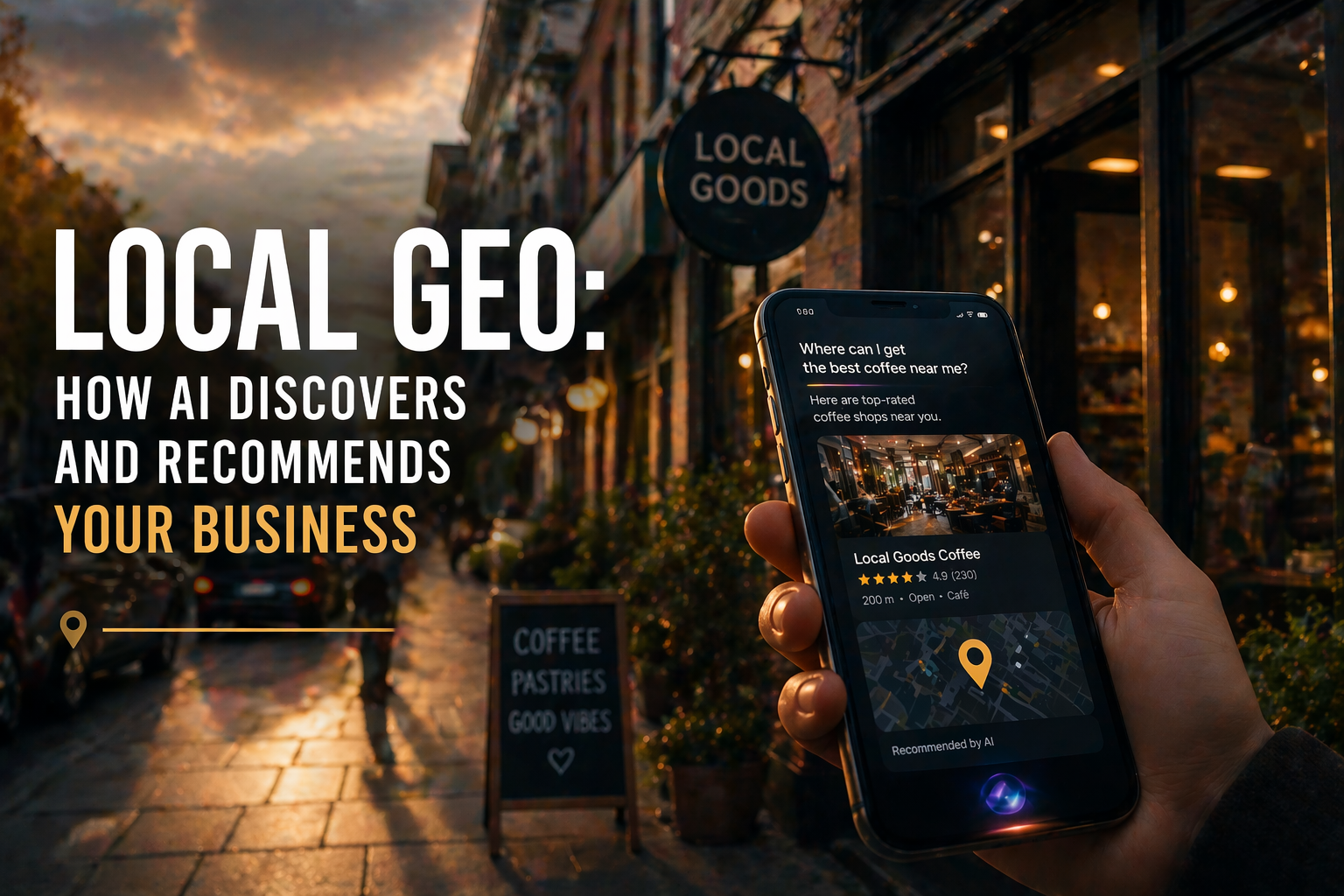
Businesses get referenced in AI answers when their local presence is structured, verifiable, and consistently aligned across platforms. AI systems do not “discover” businesses the way humans do; they retrieve entities that are clear, credible, and easy to validate. Local GEO (Generative Engine Optimization) is the process of making your business easy for AI to understand, trust, and cite in location-based queries.
Key Factors for AI Citations (Local Context)
1. Entity Clarity (Who you are, exactly)
AI prioritizes businesses with clearly defined identities. This includes a consistent name, category, services, and location. If your business is ambiguous, it is less likely to be retrieved.
2. Data Consistency Across Platforms
Your business details (name, address, phone number, services) must match everywhere: website, directories, maps, and social platforms. Inconsistency creates doubt, and AI systems avoid uncertain data.
3. Structured, Location-Specific Content
Generic content does not get cited locally. AI looks for content tied to a place, services explained within a specific city or region, with clear context and relevance.
4. Third-Party Validation (Reviews & Mentions)
AI relies heavily on external signals. Reviews, ratings, and mentions across trusted platforms act as proof that your business is real, active, and reliable.
5. Topical Authority Within a Local Niche
Businesses that consistently explain their services within a specific location are more likely to be referenced. Authority is not just what you do; it is how clearly you explain it in context.
How to Optimize for Local AI Answers
1. Define Your Business as a Clear Entity
State exactly what you do, who you serve, and where you operate. Avoid vague descriptions. Use consistent naming across all platforms.
2. Create Location-Based Content:
Write content that directly answers local queries. For example:
- “Best way to handle [service] in [city]”
- “Cost of [service] in [location]”
This makes your content retrievable for AI answering location-specific questions
3. Standardize Your Business Information
Ensure your name, address, and phone number are identical across your website, listings, and directories. Even small differences reduce trust signals.
4. Encourage and Manage Reviews
Ask customers to leave detailed, experience-based reviews. AI systems favor businesses with consistent, descriptive feedback over those with just ratings.
5. Use Structured Data (Schema Markup):
Add local business schema to your website. This helps AI systems clearly interpret your business details without guessing.
6. Answer Real Customer Questions Publicly
Turn frequently asked questions into content. The more directly you answer real queries, the more likely AI will surface your responses.
7. Keep Your Business Profiles Active and Updated
Regular updates on posts, hours, and services signal that your business is operational and reliable.
Local GEO Tools to Use
- Google Business Profile
This is the most critical tool for local visibility. It provides AI with verified business data, reviews, location signals, and activity updates. - BrightLocal
Helps track citations, manage local listings, and monitor reviews across multiple platforms to ensure consistency. - Whitespark
Useful for building local citations and identifying where your business should be listed for stronger local authority. - Schema.org
Enables you to implement structured data on your website so AI systems can clearly interpret your business information. - SEMrush
Offers local SEO tracking, keyword insights, and competitive analysis to refine your local content strategy.
Local GEO is about being recognized. The brands that show up in AI responses aren’t always the most dominant or attention-grabbing—they’re the ones that communicate with clarity and show up consistently enough to be understood and trusted.
From my perspective, most businesses are still optimizing for visibility, while AI is optimizing for certainty. That gap is where opportunity exists. If your business can remove ambiguity by being structured, verified, and locally relevant, you become easier to trust, and therefore easier to cite.
In the near future, local discovery will not depend on who shows up first but on who is understood best. And the businesses that win will be those that treat clarity, consistency, and proof not as strategies, but as infrastructure.
Read also:
The New Search Priority: A Comprehensive Guide to Generative Engine Optimization (GEO)