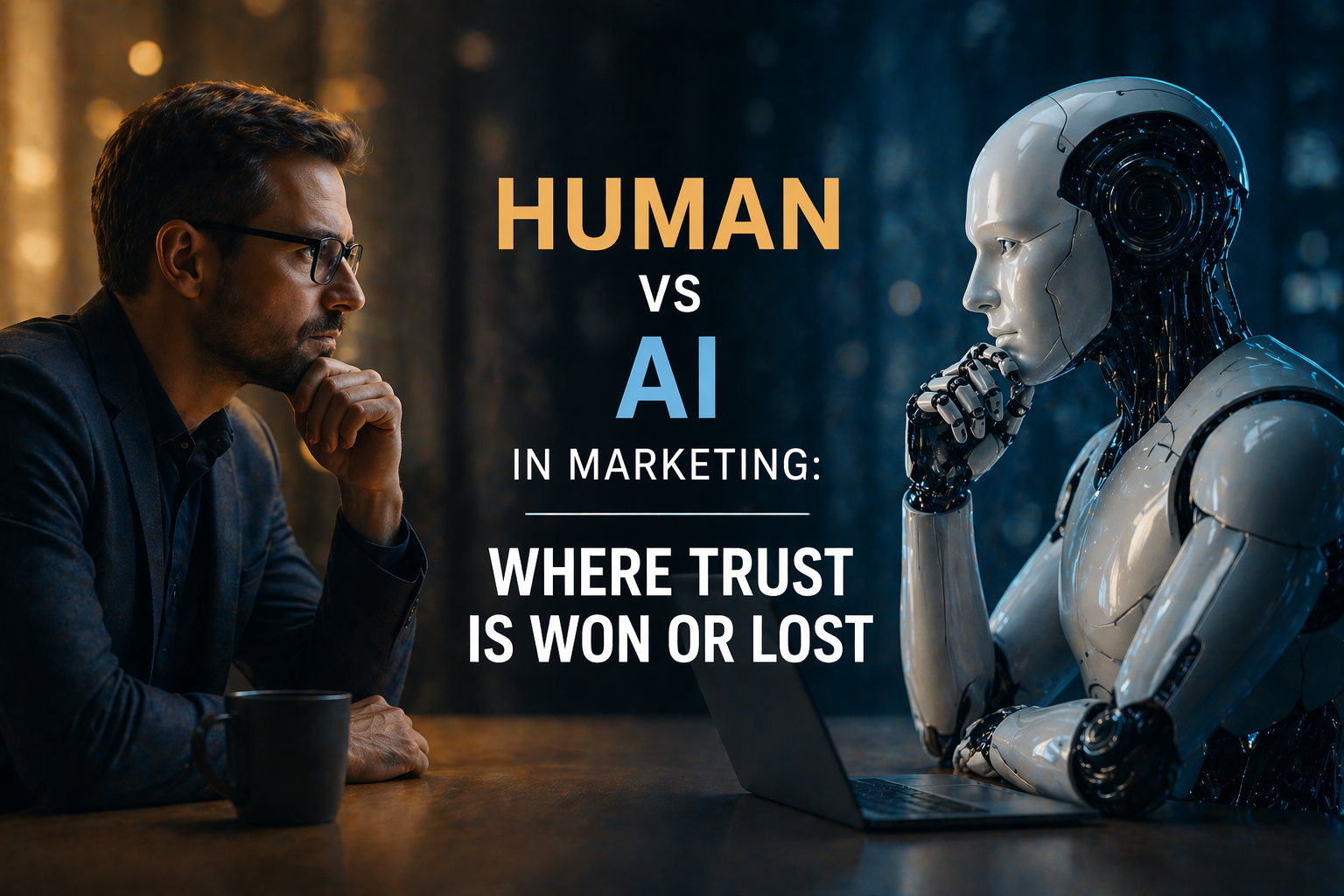
Human vs AI in Marketing: Where Trust Is Won or Lost
Marketing is no longer just about visibility, it’s about credibility. As artificial intelligence rapidly reshapes how brands communicate, analyze data, and deliver experiences, one question sits at the center of it all: who do consumers trust more; humans or machines?
AI has unlocked unprecedented capabilities. Brands can now personalize messages at scale, predict customer behavior, and automate entire campaigns. But with this power comes a trade-off. The more automated marketing becomes, the more fragile trust can be.
Human intuition, empathy, and ethical judgment still play a critical role. Meanwhile, AI brings speed, precision, and consistency. The real challenge isn’t choosing one over the other but in understanding where trust is built, and where it quietly breaks down. In today’s marketing landscape, trust is won at the intersection of authenticity, accuracy, and accountability.
Understanding Trust in Modern Marketing
Trust in marketing goes beyond simply believing a brand’s message. It’s a combination of:
- Credibility – Is the information accurate and reliable?
- Transparency – Is the brand honest about its intentions and processes?
- Consistency – Does the brand deliver the same quality experience over time?
There are also two layers of trust:
- Emotional trust – Built through relatability, storytelling, and shared values
- Rational trust – Built through data accuracy, performance, and logical consistency.
AI tends to excel at rational trust. Humans dominate emotional trust. The most effective marketing blends both.
Why Trust Drives Conversions and Loyalty
Trust directly influences:
- Purchase decisions – Consumers are more likely to buy from brands they trust
- Customer retention – Trust reduces churn and increases loyalty
- Brand advocacy – Trusted brands benefit from word-of-mouth and referrals
Without trust, even the most sophisticated marketing campaigns fail to convert.
The Strengths of Human-Driven Marketing
Emotional Intelligence and Storytelling
Humans understand nuance. We read tone, context, and cultural signals in ways AI still struggles with. Great marketing stories tap into real emotions, reflect shared experiences and adapt to cultural sensitivities. This is why human-led campaigns often feel more memorable and meaningful.
Authenticity and Brand Voice
Authenticity is difficult to fake, and easy to lose. Human marketers develop unique brand personalities, communicate with sincerity and avoid sounding overly scripted or generic. Audiences today can quickly detect content that feels artificial. A human touch helps brands stay relatable.
Ethical Judgment and Accountability
AI can generate content, but it doesn’t take responsibility for it. Humans are essential when navigating sensitive topics, responding to public backlash and making ethical decisions. Trust is reinforced when brands show accountability, something only humans can truly own.
The Power of AI in Marketing
Data-Driven Personalization at Scale
AI thrives on data. It can analyze massive datasets to predict customer preferences, deliver hyper-targeted messaging and optimize timing and channels. This level of personalization would be impossible manually.
Speed, Efficiency, and Automation
AI dramatically reduces the time required to generate content, launch campaigns and analyze performance. What, in the past, will take weeks to be accomplished can now happen in minutes. This efficiency allows marketers to scale faster than ever.
Consistency and Performance Optimization
AI ensures consistent messaging across platforms, continuous A/B testing and real-time performance adjustments. It removes guesswork and replaces it with measurable optimization.
Where Trust Is Won with AI
Accuracy and Relevance
When AI works well, it delivers:
- Highly relevant recommendations
- Timely messaging
- Useful, data-backed insights
This builds rational trust, as users feel understood and valued.
Seamless Customer Experiences
AI power chatbots, recommendation engines and automated customer journeys. When executed properly, these systems create smooth, frictionless experiences that increase satisfaction.
Transparency Through Data
AI enables brands to show: Measurable results. clear performance metrics and evidence-based decisions. This transparency strengthens credibility.
Where Trust Is Lost with AI
Over-Automation and Lack of Human Touch
Too much automation leads to robotic responses, generic content and emotional disconnect. Customers don’t want to feel like they’re talking to a machine, even if they are.
Bias, Errors, and Misinformation
AI systems can reflect biased data, generate incorrect information and produce misleading outputs. When this happens, trust erodes quickly, sometimes permanently.
Privacy Concerns and Data Misuse
Modern consumers are increasingly aware of how their data is collected, used and whether it is secure. Over-personalization can feel invasive, crossing the line from helpful to unsettling.
Where Humans Still Win: Why It Matters
Crisis Communication and Brand Reputation
During a crisis, tone matters more than speed. Human-led responses show empathy. address concerns thoughtfully, and when applicable, rebuild damaged trust. AI cannot replicate genuine emotional sensitivity in high-stakes situations.
Creativity Beyond Patterns
AI generates based on patterns. Humans create beyond them. Human creativity breaks norms while introducing originality and drives innovation. This is where humans standout.
Building Long-Term Relationships
Trust is not built in a single interaction. Humans excel at community building, nurturing relationships as well as building and maintaining long-term engagement. These are the foundations of brand loyalty.
The Hybrid Future: Human and AI Collaboration
Augmented Marketing Teams
The future isn’t AI replacing humans, but AI assisting them. While AI handles repetitive tasks, provide insights and enhance decision-making, humans then interpret results, add emotional depth and make strategic choices.
Best Practices for Integration
To balance trust effectively:
- Keep humans in the loop
- Use AI for support, not control
- Regularly audit AI outputs
- Maintain a clear brand voice
Case Examples or Scenarios
Successful brands often:
- Use AI for personalization
- Use humans for storytelling
- Combine automation with human customer support
This hybrid model consistently delivers both efficiency and trust.
Actionable Framework: How to Build Trust in AI-Driven Marketing
- Balance automation with human oversight
- Be transparent about AI usage
- Prioritize data ethics and privacy
- Continuously test and improve trust signals
Common Mistakes to Avoid
- Blind reliance on AI tool
- Ignoring audience perception
- Over-personalization
- Losing authenticity
Future Trends: Trust in the Age of Generative AI
- Rise of AI-generated content saturation: As AI content becomes widespread, the difference will depend on originality and authenticity.
- Demand for authenticity: Consumers will increasingly ask for real voices, human stories and verified experiences.
- Regulatory and Ethical Evolution: There will be tighter regulations around data usage, AI transparency and consumer protection. Brands that proactively adapt will gain trust faster.
To know the true entity of intelligence in marketing, read the article; What Real Marketing Intelligence Looks Like