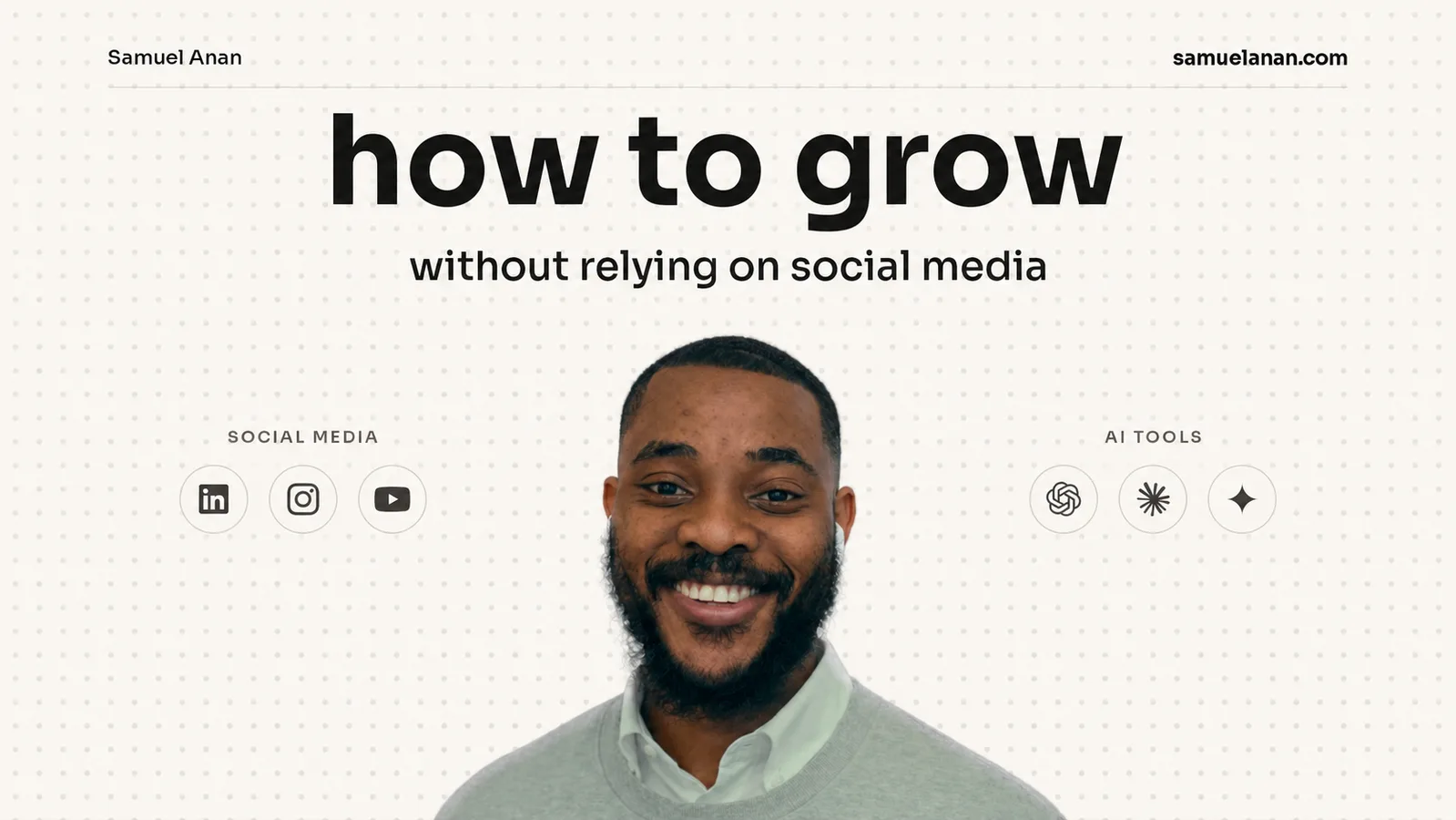
On the pressure to be visible, and how Google, AI search and other people can help your work find an audience.
By Samuel Anan, London-based GEO specialist
If you’ve ever put your phone down after scrolling and felt a little worse about where you are in life, I’m writing this for you. Maybe someone in your line of work has built the kind of following you thought you’d have by now. Maybe you’ve tried filming yourself, watched the clip back and decided you couldn’t bear to post it. And maybe, after enough of those days, you’ve started to wonder what this means for your future.
Take a breath. The skill it takes to speak into a camera and keep people watching is one skill among many. You can be thoughtful, ambitious and excellent at what you do and still find the demands of social media exhausting. You might have a business to run or people to look after. You might simply do your best thinking when you have time to sit with a question. Those are reasonable things to build your working life around.
I work in generative engine optimisation, or GEO, in London. I spend a lot of time thinking about how people and businesses get discovered. For all the time I’ve spent talking about visibility, I’ve given too little attention to how it feels to be told that your career or business depends on showing up in a way that feels wrong for you.
Can you grow a business with a small social media following?
Social media can open doors. A good post can introduce you to a client you might never have met. A founder who enjoys talking to customers on camera can build a community around the work. I understand why people take it seriously, and why it can hurt to watch others make it look easy.
But think about the last time you needed to hire someone or buy something you knew very little about. You might have asked a colleague who they’d used, searched Google, read a few reviews or looked for a useful comparison. Each of those routes gives someone a chance to come across your work at the moment it matters to them.
How I discovered Hostinger through Google and ChatGPT
I first came across Hostinger while looking for answers through ChatGPT and Google. I found enough useful information to look into the company, and by the time I opened its Instagram profile, I already had a reason to follow.
I remember seeing around 30,000 Instagram followers when I first followed Hostinger, while some competitors’ accounts were already above 200,000. I’ve since seen Hostinger’s Instagram following pass 100,000. Those figures are my recollection. What I can speak to directly is how the company earned one of those follows: I came with a question, found a brand worth looking into and chose to follow it after I’d begun to trust what I’d found.
I sometimes think about what would have happened if I’d started by comparing Instagram profiles. The largest following would have been an easy signal to lean on. Starting with my question gave me a different way to judge which company deserved a closer look.
Since I discovered Hostinger through ChatGPT and Google, I’ve spent well over £1,000 with them. That’s from one person who came across their name while looking for an answer.
Now imagine 1,000 people finding Hostinger the way I did and going on to become paying customers. Then imagine 100,000 paying customers. Then a million.
Related reading: How to Report AI Visibility to Clients, How to Build a Verifiable About Page for AI Search, What to Include on a Business About Page People Can Verify.
How SEO and GEO help people discover your work
Imagine someone searching for a web designer who has worked with independent shops. They might type a short query into Google or ask an AI search tool a longer question about what to look for. Either way, they have a problem they’re trying to solve. A page showing how you helped a shop make online orders easier gives them something specific to evaluate. A client review or recommendation can give them a reason to take the next step.
Search engine optimisation (SEO) helps people find that page through search. Generative engine optimisation (GEO) focuses on making your work easier to discover and accurately describe in AI-generated answers. Google says its AI search features build on the same SEO fundamentals as regular Search, including making useful content accessible and linking to it clearly from elsewhere on your site. Google Search Central
If you have an hour to put into this, start with one question customers or colleagues already ask you. Answer it in the words you’d use in a conversation and put the answer somewhere people can share it. For a business, that could be a service page explaining what a first appointment involves. For someone looking for work, it could be a portfolio page describing one problem you solved and what you contributed. Either gives the next person who mentions your name something concrete to pass along.
What the data says about AI search and customer discovery
Adobe Analytics recorded a 693.4% year-on-year increase in visits to U.S. retail sites from generative AI tools during November and December 2025, from what Adobe described as a modest base. That measures visits made by clicking through from AI tools in one retail market and period. Adobe Analytics holiday shopping report
Pew Research Center looked at what people clicked on Google. In its analysis of March 2025 U.S. browsing data, people clicked a traditional result on 8% of Google search visits with an AI summary, compared with 15% of visits without one. Links inside the summaries drew clicks on 1% of visits with a summary. If you’re tracking how people find your business, it’s worth looking at where you’re mentioned as well as what brings in visits or enquiries. Pew Research Center’s Google browsing study
What people find when they do look further matters, too. In BrightLocal’s 2026 survey of 1,002 U.S. adults, 54% said they would visit a local business’s website after reading a positive review. Twenty-four per cent said they would check the business’s social media. The answers describe what respondents said they would do after a review, and they illustrate why a clear website deserves some of the attention we give our feeds. BrightLocal’s Local Consumer Review Survey
Build a way to be found that you can sustain
If you’ve spent months trying to make yourself comfortable on a platform and still dread opening it, you’re allowed to put some of that energy elsewhere. Get back in touch with someone who knows your work. Put the project you’re proudest of on your website and explain your part in it. Give the next person who’s looking for help a way to find you and decide for themselves.
That’s why I created sparlab(Sparlab.io). I wanted to help people who do good work make it easier for customers to find them on Google and in AI search results. If you’d like help figuring out where to start, you can message me on Instagram or request a free consultation. We can look at where your work shows up today and find one step you can take from there.
And if today all you can do is put the phone down and take a breath, that’s all right too. Give yourself a little time. You may simply need another way forward.