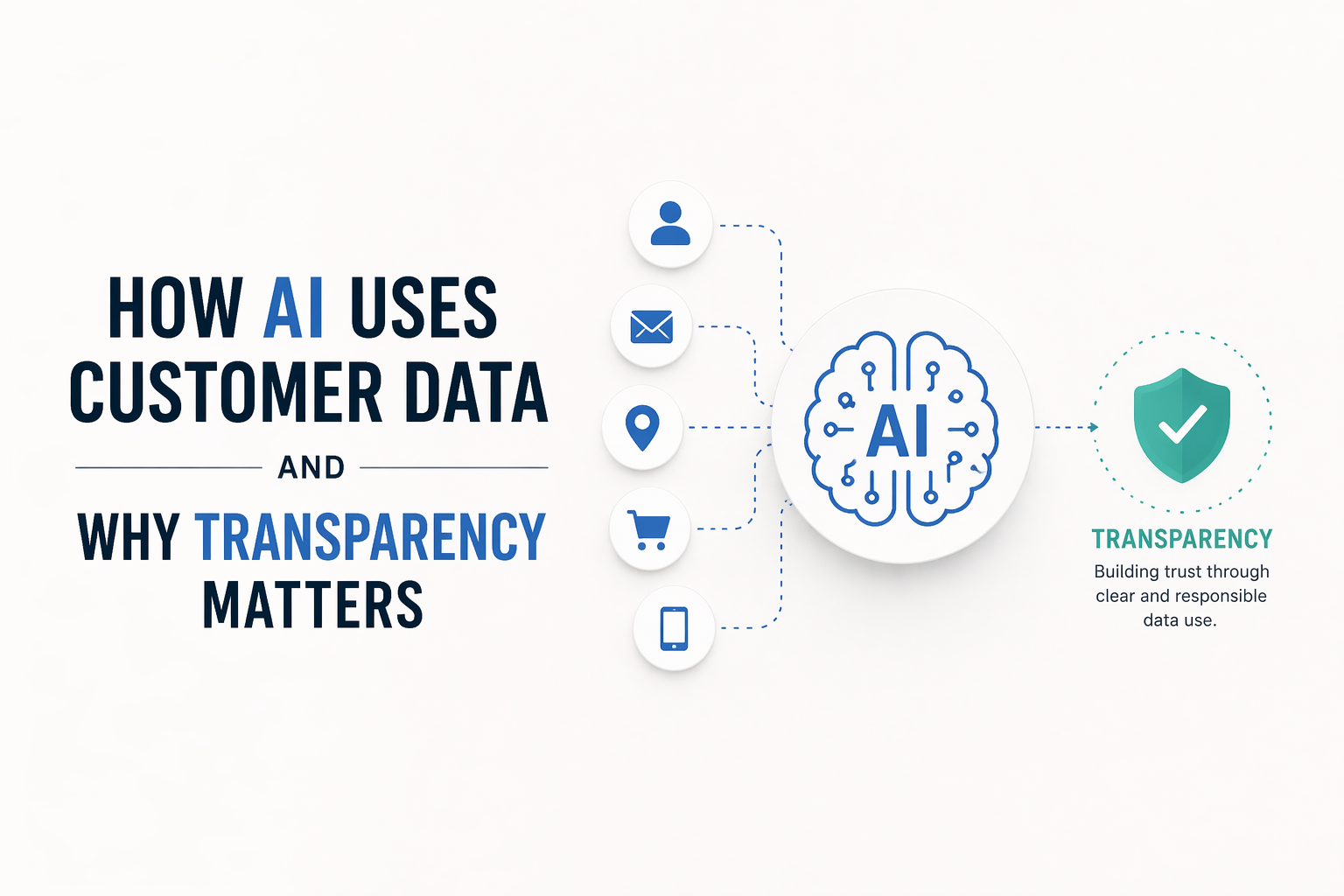
How AI Uses Customer Data and Why Transparency Matters
Artificial intelligence (AI) is transforming how businesses interact with customers, make decisions, and deliver services. From personalized product recommendations to intelligent chatbots, AI is now deeply embedded in everyday digital experiences. At the core of all these innovations lies one powerful resource: customer data.
Every click, purchase, search query, and interaction contributes to a growing pool of information that AI systems use to learn and improve. While this enables businesses to create more relevant and efficient experiences, it also raises critical questions about privacy, trust, and ethical responsibility.
As AI continues to evolve, transparency is essential. Businesses that openly communicate how they collect and use customer data are better positioned to build trust, comply with regulations, and maintain long-term customer relationships.
What Is Customer Data in AI?
Customer data refers to any information collected from users that can help businesses understand behavior, preferences, and needs. In the context of AI, this data is used to train algorithms, generate insights, and automate decision-making.
Types of Customer Data Collected
AI systems rely on multiple types of customer data to function effectively:
Personal Data
Information such as names, email addresses, phone numbers, and demographic details
Behavioral Data
User actions like clicks, browsing patterns, time spent on pages, and interactions with content
Transactional Data
Purchase history, payment methods, and order frequency
Device and Location Data
IP addresses, device types, geolocation, and operating systems
Each type of data provides a different layer of insight, helping AI systems create a more complete picture of the customer.
How AI Systems Access and Process Data
AI collects and processes data through several channels, including websites, mobile apps, cookies, APIs, and third-party integrations. Once collected, the data goes through a pipeline:
Data Collection
Gathering raw information from multiple sources
Data Cleaning
Removing inconsistencies or errors
Data Training
Feeding data into machine learning models
Data Analysis
Generating predictions or insights
Some AI systems operate in real time, delivering instant responses (like chatbots), while others analyze large datasets over time to uncover trends.
How AI Uses Customer Data
AI leverages customer data in powerful ways that directly impact both user experience and business performance.
Personalization and Recommendations
One of the most visible uses of AI is personalization. By analyzing user behavior and preferences, AI can do the following:
- Recommend products based on past purchases
- Curate content feeds tailored to individual interests
- Send targeted email campaigns
This level of personalization enhances user satisfaction and increases engagement.
Predictive Analytics
AI uses historical data to predict future behavior. This includes:
- Identifying customers likely to stop using a service (churn prediction)
- Forecasting demand for products
- Anticipating customer needs before they arise
Predictive analytics helps businesses make proactive decisions rather than reactive ones.
Automation and Decision-Making
AI automates processes that traditionally required human input:
- Chatbots handling customer inquiries 24/7
- Fraud detection systems identifying suspicious activity
- Dynamic pricing models adjusting prices in real time
This improves efficiency while reducing operational costs.
Customer Segmentation
AI groups customers into segments based on shared characteristics or behaviors. This allows businesses to deliver targeted marketing campaigns, improve product development and enhance customer journey mapping. Segmentation ensures that communication is relevant and effective.
Benefits of AI Using Customer Data
When used responsibly, AI-driven data utilization offers significant advantages. These are discussed as follows:
Improved Customer Experience
AI enables faster, smarter, and more personalized interactions. Customers receive relevant recommendations, quicker support, and seamless digital experiences.
Business Efficiency
Automation reduces manual tasks, allowing teams to focus on strategic initiatives. AI also improves decision-making by providing data-driven insights.
Increased Revenue Opportunities
By understanding customer behavior, businesses can:
- Upsell and cross-sell effectively
- Increase conversion rates
- Improve customer retention
This directly contributes to higher profitability.
Risks and Concerns Around Customer Data Use
Despite its benefits, the use of customer data in AI comes with serious risks that businesses must address.
Privacy Issues
Many users are unaware of how much data is being collected about them. Over-collection and lack of transparency can lead to privacy violations.
Data Security Risks
Customer data is a valuable asset—and a major target for cybercriminals. Data breaches can expose sensitive information, leading to financial and reputational damage.
Bias in AI Models
AI systems are only as good as the data they are trained on. If the data contains biases, the AI can produce unfair or discriminatory outcomes.
Loss of Customer Trust
When customers feel their data is being misused or mishandled, trust erodes quickly. Rebuilding that trust can be extremely difficult.
Why Transparency in AI Matters
Transparency is the foundation of ethical AI and sustainable business growth.
Building Trust with Customers
Customers are more likely to engage with brands that are open about their data practices. Transparency fosters confidence and loyalty.
Regulatory Compliance
Governments around the world are enforcing stricter data protection laws, such as the General Data Protection Regulation (GDPR) and the California Consumer Privacy Act (CCPA). Transparency helps businesses stay compliant and avoid penalties.
Ethical Responsibility
Using AI responsibly means ensuring fairness, accountability, and respect for user privacy. Transparency is key to achieving these goals.
Competitive Advantage
Businesses that prioritize transparency can differentiate themselves in crowded markets. Trust becomes a unique selling point.
Key Principles of Transparent AI Data Usage
To build transparent AI systems, businesses should follow key principles that prioritize user rights and ethical practices.
Clear Data Policies
Privacy policies should be easy to understand, not filled with complex legal jargon. Customers should know exactly what data is collected and why.
User Consent and Control
Users should have control over their data, including:
- Opt-in and opt-out options
- Access to their stored data
- The ability to delete their information
Explainable AI
AI decisions should be understandable. Businesses must be able to explain how and why certain outcomes are generated.
Accountability
Organizations should implement audits, governance frameworks, and oversight mechanisms to ensure responsible data usage.
Best Practices for Businesses
To balance innovation with responsibility, businesses must adopt practical strategies.
Implement Privacy-by-Design
Privacy should be integrated into systems from the beginning, not added as an afterthought.
Minimize Data Collection
Collect only the data that is necessary. Excess data increases risk without adding value.
Invest in Data Security
Strong security measures such as encryption, firewalls, and continuous monitoring are essential to protect customer data.
Communicate Transparently
Regularly update customers about data practices, policy changes, and security measures. Open communication builds long-term trust.
Future Trends in AI and Data Transparency
The landscape of AI and data privacy is rapidly evolving.
Rise of Ethical AI
More organizations are adopting ethical AI frameworks to ensure fairness and accountability in their systems.
Increased Regulation
Governments are introducing stricter laws to protect consumers, making transparency a legal requirement rather than a choice.
Consumer Awareness Growth
Customers are becoming more informed about their data rights and are demanding greater control and transparency.
Key Points
AI has revolutionized how businesses use customer data, enabling smarter decisions, personalized experiences, and increased efficiency. However, with great power comes great responsibility.
Transparency is the key to unlocking the full potential of AI while maintaining trust and ethical integrity. Businesses that prioritize clear communication, data protection, and user control will not only comply with regulations but also build stronger, more lasting relationships with their customers. In a world driven by data, trust is the ultimate currency and transparency, is how you earn it.
Read also: Data Privacy in AI Marketing: What You Need to Know
I am Samuel Anan, let’s evolve together, let’s be ever contemporary. It’s a fast moving world!